Top 10 Types of Flexible LED Strip Lights for Buyers
Flexible LED strip lights can look similar in a product photo, yet perform very differently once installed. A strip beneath a kitchen cabinet faces grease, heat, and long daily use. One tucked into a display shelf needs smooth, even light. For this guide, lighting designer Jason Livingston’s design-first approach is paraphrased as: “Choose the light for the task, then check how it will be installed and controlled.” This is a summary, not a verbatim quotation.
The top 10 types of Flexible Led strips give buyers a practical way to compare options, from single-color and tunable-white strips to RGB, RGBW, COB, and waterproof designs. Small details matter. Check voltage, brightness, color rendering, cut intervals, dimming compatibility, and the strip’s stated protection rating. A glossy package may show a vivid color, but it cannot tell you whether the light will appear dotted beneath a cabinet. Nor does a strong adhesive guarantee a lasting bond on dusty or warm surfaces.
Fit comes first. Then output. Then controls. Measure the route, note corners and gaps, and consider an aluminum channel where heat management or a cleaner finish matters. Match the power supply to the strip’s voltage and load, and follow the manufacturer’s installation guidance. Some product listings leave important details unclear; treat that as a reason to verify, not guess. The right choice depends on the room, the surface, and the result you actually need.
How Flexible LED Strip Lights Are Built and Classified
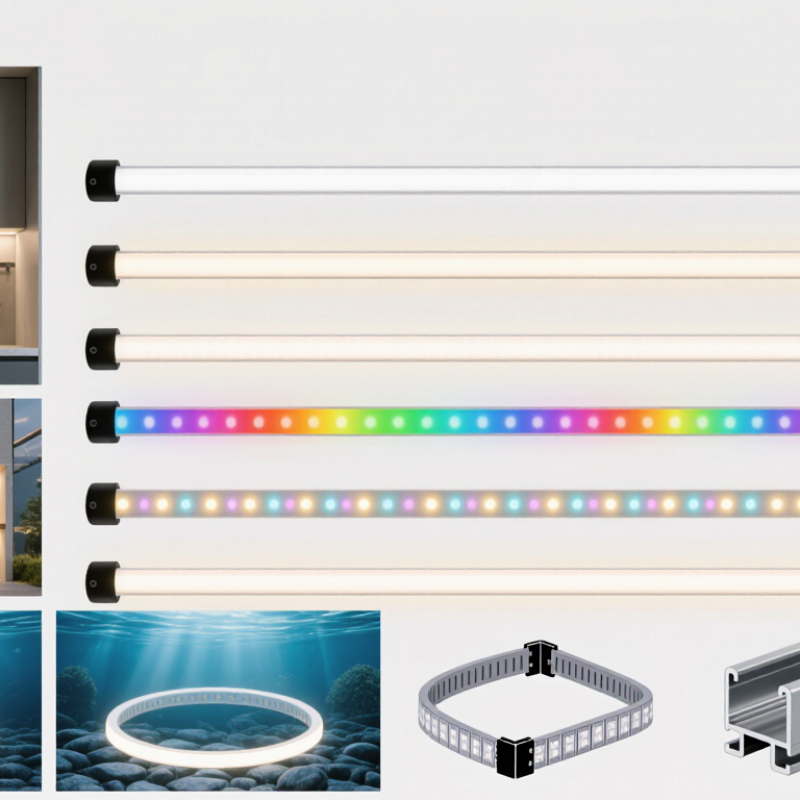
Flexible LED strip lights are built from surface-mounted diodes on a flexible printed circuit board, usually copper traces laminated to a polymer base. A cut line marks where the circuit can be shortened safely; cutting elsewhere may break the electrical path. Resistors or driver components regulate current, while a silicone sleeve or coating can protect the assembly from moisture and dust. Tiny details matter.
Buyers can classify strips by diode package, LED density, color output, voltage, and protection level. Higher diode density often produces smoother light, especially in shallow channels, but it can also increase power demand and heat. White strips may use fixed color temperatures or tunable white LEDs; RGB versions mix colored emitters, though their white light may appear less natural. IP ratings follow IEC 60529 and describe protection against dust and water, not overall product quality. The distinction is easy to overlook.
The U.S. Department of Energy’s 2019 Energy Savings Forecast projected that LED lighting across general illumination could save 569 terawatt-hours annually by 2035. That figure covers lighting broadly, not flexible strips specifically, so it should not be used to predict a strip’s efficiency. Check the actual lumen-per-watt rating, voltage, and heat-management guidance. A dense strip inside a sealed channel may run hotter than expected.
The Ten Main Types of Flexible LED Strip Lights
Flexible LED strips are best understood by their light output, control method, and construction. The ten common buyer categories are single-color, tunable-white, RGB, RGBW, addressable, high-density, COB, silicone-neon, side-emitting, and waterproof strips. Single-color strips suit shelves and task lighting; tunable-white versions shift from warm to cool white. RGB creates colored effects, while RGBW adds a dedicated white channel. Addressable strips control individual LED sections, useful for moving patterns. High-density and COB designs reduce visible gaps between light points. Silicone-neon strips diffuse light through a rounded jacket, and side-emitting types direct light sideways into narrow details. Waterproof versions add protective coatings or sleeves.
These categories overlap. A waterproof strip may also be RGBW, so buyers should compare specifications rather than rely on labels alone. The U.S. Department of Energy’s 2020 U.S. Lighting Market Characterization estimated that LEDs represented about 47% of installed lighting stock nationwide; this figure covers lighting broadly, not flexible strips specifically. For a kitchen run, check color temperature, brightness per meter, and voltage drop before installation. For bathrooms or outdoor edges, verify the stated ingress protection rating and seal every cut end. Small detail. A low-voltage strip can still dim near its far end if the run is long or undersized. I would treat adhesive strength as a test item, too; a clean surface does not guarantee lasting adhesion.
How Strip Types Differ in Brightness, Color, and Control
Flexible strips differ less by label than by output per meter, emitter spacing, and optics. A 5-meter roll with widely spaced diodes can show dots on glossy cabinet fronts. COB strips create a smoother line, though heat and driver sizing still matter. Compare lumens per meter, not watts alone, and check the datasheet at the intended voltage. The U.S. Department of Energy’s 2022 Solid-State Lighting R&D Opportunities report notes that advanced LED packages exceed 200 lumens per watt. That is package-level performance, not guaranteed strip output. Boards, coatings, and heat can reduce real-world light. A small but important distinction.
Single-color strips provide steady white or one hue; tunable-white models shift from warm to cooler task lighting. RGB strips create saturated colors, while RGBW adds a dedicated white emitter for more usable pale tones. Individually addressable strips control pixels or short segments; basic analog strips change together. Check controller channels, dimming range, and power injection before installation. DOE’s LED Lighting guidance reports that LEDs use at least 75% less energy than incandescent lighting, but that comparison cannot predict a particular strip’s brightness. I still find color labels misleading: “white” can vary in tint and color rendering. Ask for CCT, CRI, and lumen-per-meter figures, then test a short sample beside the actual wood, paint, or tile.
Top 10 Types of Flexible LED Strip Lights for Buyers - How Strip Types Differ in Brightness, Color, and Control
The brightness figures below are indicative ranges for common products, not guaranteed specifications. Actual output varies with LED density, power, voltage, optics, and installation. These categories can overlap—for example, a waterproof strip can also be RGB or tunable white.
| Strip type | Typical brightness | Color and white-light capability | Typical control | Common applications and buyer notes |
|---|---|---|---|---|
| 1. Single-color white | Often about 300–1,500 lm/m, depending on LED density and power. | One fixed white color temperature, commonly offered from warm white to cool white. | On/off switch, compatible dimmer, or PWM controller. | Straightforward task and accent lighting. Choose the color temperature and dimmer compatibility before purchase. |
| 2. Tunable-white (CCT) | Commonly around 400–1,500 lm/m; output can vary across the white-temperature range. | Adjustable white, typically blending warm-white and cool-white LEDs across a stated CCT range. | Two-channel CCT controller, compatible dimmer, or smart controller. | Useful when the preferred white tone changes by time or task. Requires a controller designed for CCT strips. |
| 3. RGB color-changing | Varies substantially by color and product; mixed white is usually less suitable than a dedicated white LED strip. | Red, green, and blue channels mix to create many colors. Usually lacks a separate high-quality white channel. | RGB controller, remote, wall control, or compatible smart system. | Decorative and mood lighting. Do not assume RGB-generated white will match the color quality of a dedicated white strip. |
| 4. RGBW | Color output depends on the selected channels; the separate white channel provides dedicated white illumination. | RGB colors plus a separate white LED channel, often available in a specified white temperature. | Four-channel RGBW controller or compatible smart controller. | A practical choice for both colored effects and regular white lighting. Confirm whether the white channel is warm, neutral, or cool. |
| 5. RGB+CCT | Output depends on the active color and white channels; check the product’s channel-specific data. | RGB colors plus adjustable warm-to-cool white, usually using separate warm- and cool-white channels. | Multi-channel controller matched to the strip’s wiring and channel layout. | Offers both color effects and adjustable white. Check controller compatibility, wiring, and power requirements carefully. |
| 6. Addressable RGB (pixel) | Brightness varies by LED package, pixel density, and effects; lumens per meter are not consistently comparable across products. | Individually controlled pixels or pixel groups can display multiple colors and animated patterns along one strip. | Digital pixel controller and compatible data protocol; some versions use 5 V, 12 V, or other specified supply voltages. | For animations and dynamic effects. Verify the protocol, pixel grouping, voltage, data direction, and controller support. |
| 7. COB (continuous-light) strip | Commonly about 300–1,500 lm/m, with output determined by the specific product and power rating. | Available in single-color white and, in some product ranges, other color configurations. Closely spaced emitters create a more continuous line of light. | Usually a compatible single-color dimmer or the controller specified for the particular model. | Helpful where visible LED dots are undesirable. Confirm the cut points, mounting surface, and required power supply. |
| 8. High-CRI white strip | Often about 300–1,200 lm/m; high color quality does not by itself indicate high brightness. | Fixed white CCT with a high color-rendering index (commonly CRI 90 or above when specified). | Single-channel dimmer or on/off control, depending on the model. | Suitable where accurate appearance of colors matters, such as display, dressing, or work areas. Check the stated CRI and test conditions. |
| 9. High-voltage AC strip | Product-dependent; compare the manufacturer’s stated lumens per meter and input power rather than assuming a fixed output. | Usually a fixed color per strip; color options depend on the product range. | Mains-rated connector and compatible control or dimmer, if dimming is supported. | Can suit longer runs with fewer low-voltage injection points, but involves mains voltage. Use the specified accessories and qualified installation practices. |
| 10. Sealed or waterproof-rated strip | No standard brightness range: output depends on the underlying LED strip; sleeves or coatings may affect light output and heat dissipation. | May be single-color, tunable white, RGB, or another configuration. | Controller depends on the underlying strip; connections and cut ends must retain the required protection. | Choose an IP rating appropriate to the exposure. An IP rating describes protection under specified test conditions; it does not mean every installation is suitable for immersion. |
Before buying, compare the specified lumens per meter, watts per meter, voltage, color temperature, CRI, cut length, dimming method, and required power supply. For longer low-voltage runs, check the manufacturer’s guidance on voltage drop and power injection.
Matching a Strip Light Type to Its Intended Application
Choosing a flexible LED strip starts with the surface and the job. For a dry living-room cove, a standard indoor strip is often enough. A high-density strip can reduce visible gaps when mounted close to a wall or shelf. For a smooth, continuous line, COB strips hide individual light points well. Check the diffuser, too; even a good strip can look uneven behind a shallow cover.
Moisture changes the choice. A coated strip suits a kitchen backsplash where occasional splashes are possible, while a fully sealed version is better for exposed outdoor areas. Sealing can make installation bulkier, so measure corners and channels before buying. Measure twice. For desk lighting or workbenches, neutral white light gives useful visibility; tunable-white strips offer more flexibility in rooms used throughout the day. RGB or RGBW types fit accent lighting, but color effects rarely replace clear task lighting.
Power and control matter as much as appearance. A 24-volt strip can help limit brightness loss over longer runs, though the actual result depends on strip design, wire size, and installation length. Side-emitting strips can follow narrow curves or outline signs. Confirm cut marks, connector compatibility, and the power supply’s capacity before installation. A frequent oversight is choosing by brightness alone. The mounting surface, heat buildup, and access for future repairs deserve attention, even when the strip looks simple to fit.
What Buyers Should Check Before Choosing a Strip Light
Before choosing a flexible LED strip, check where it will be installed and how long each run needs to be. Measure corners, cabinet edges, and the distance to the power outlet. A strip may be cut only at marked points, so a few centimeters can matter. Small details matter.
Match the strip’s voltage to its power supply, and leave some capacity for the full run. Check brightness in lumens per meter, not just the number of LEDs. For kitchens or work areas, color rendering can affect how food and surfaces look. Warm white often feels softer; cool white can make task areas appear clearer. Neither is right everywhere. If you need dimming, confirm that the controller and power supply support the same method.
Look closely at the IP rating if the strip will sit near sinks, outdoors, or in a humid room. The rating describes protection, but it does not make every connector or cut end waterproof. Adhesive can also fail on dusty, rough, or warm surfaces; clean and dry the mounting area first. On a test piece, check for uneven brightness and unwanted color shifts before installing the full length. A quick test helps, though it cannot predict every issue after installation.
Related Posts
-
What Is LED Custom Lighting for Global Buyers?
-
Unlocking Global Opportunities: Explore the Future of Flexible LED Panels at the 138th Canton Fair
-
Unveiling the Best Flexible LED Panel with 15 Advanced Features for Ultimate Lighting Solutions
-
Exploring LED Flex Innovations at the 138th Canton Fair 2025: Industry Growth Insights and Market Trends
-
Transforming Retail Spaces with Led Flex: Real-World Applications and Practical Installation Tips
-

What Are the China Top 10 LED Flex Manufacturers?