
What Are the China Top 10 LED Flex Manufacturers?
Choosing the right Led Flex manufacturer in China requires more than comparing prices or browsing attractive product photos. Real evaluation begins with factory experience, engineering depth, and consistent production evidence. This article examines ten leading manufacturers through practical criteria, including LED efficiency, color consistency, PCB quality, thermal management, bending radius, waterproof protection, and adhesive performance. Samples matter. So do factory audits, aging tests, and customer references.
LED industry pioneer Dr. Roland Haitz famously observed, “Every decade, the cost per lumen falls by a factor of 10, while the amount of light generated by an LED increases by a factor of 20.” His statement remains useful here because Led Flex products continue evolving quickly. A lower price may hide weaker copper traces, unstable drivers, or poor heat dissipation. Those details become visible when a strip runs continuously inside a narrow sign channel.
This ranking is not presented as an unquestionable verdict. No list is perfect. Supplier capabilities can change, and online information may remain incomplete. We therefore focus on verifiable signals, such as certifications, production capacity, warranty terms, customization support, and export experience. Some manufacturers may excel in architectural lighting, while others perform better in signage, retail displays, or outdoor installations. Buyers should still request current samples and technical datasheets before ordering. The strongest supplier is not always the largest one. It is the company that can repeatedly deliver the promised brightness, color, flexibility, and service under real operating conditions.
What Defines a Leading LED Flex Manufacturer in China?
What Are the China Top 10 LED Flex Manufacturers?
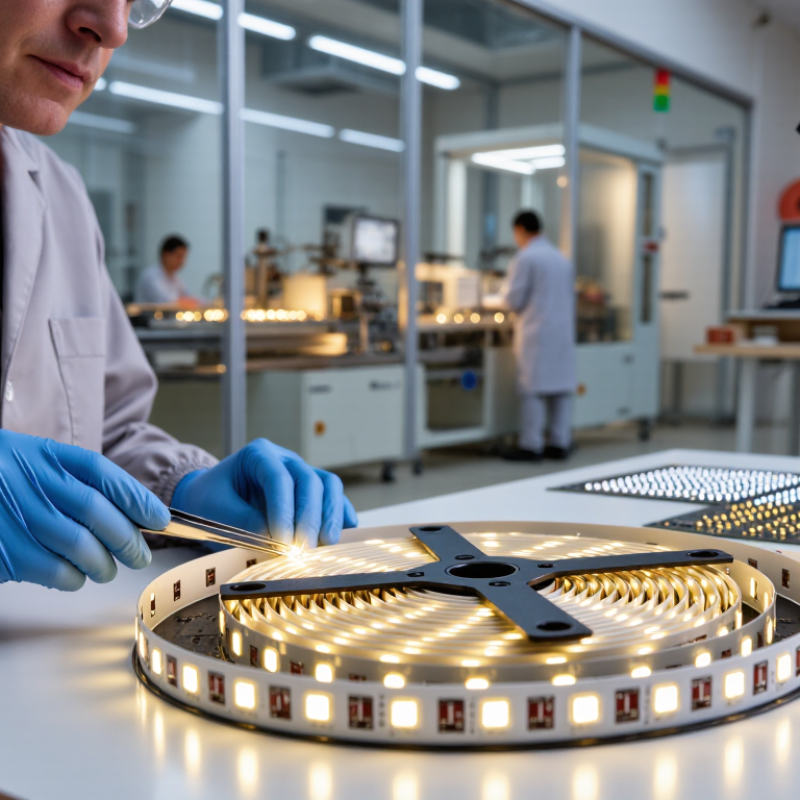
A leading LED flex manufacturer in China proves performance beyond a polished catalog. Reliable suppliers show measured brightness, color consistency, power stability, and thermal results. They explain LED binning, circuit design, adhesive selection, and protection ratings in practical terms. Their production lines should include aging tests, solder checks, waterproof inspections, and final electrical testing. Ask for recent test reports, sample records, and traceable batch information. Numbers can mislead.
Experience also appears in the details. A capable manufacturer can recommend suitable voltage, pixel spacing, silicone hardness, bending limits, and installation methods. They understand how heat, moisture, dust, and tight corners affect long-term performance. Strong technical teams respond clearly when specifications change. They also document tolerances instead of promising perfection. No factory is perfect. Honest limitations often reveal better professional judgment.
Tips: Request samples from different production batches. Test brightness after extended operation, not only when unpacked. Check whether the quoted IP rating matches independent testing. Review packaging, connector strength, and cutting marks. Ask how defects are recorded and replaced. A supplier that avoids detailed questions may create expensive problems later. Small practical checks often distinguish a dependable manufacturer from a merely attractive quotation.
How China’s LED Flex Manufacturing Industry Has Evolved
What Are the China Top 10 LED Flex Manufacturers?
China’s LED flex manufacturing industry has moved beyond low-cost assembly. Earlier production focused on standard 12-volt strips, basic copper boards, and short product cycles. Today, factories increasingly use automated placement lines, silicone extrusion, optical testing, and tighter binning controls. In practical sourcing work, the visible difference appears in solder joints, color consistency, and heat management. Small details matter.
Grand View Research valued the global LED lighting market at about US$78 billion in 2023. It also projected double-digit annual growth through 2030. This demand has pushed Chinese manufacturers toward flexible neon, high-density strips, addressable lighting, and outdoor-rated designs. TrendForce’s recent LED industry analysis also highlights stronger demand for higher-efficiency emitters and advanced packaging. The manufacturing floor is changing.
The top ten should not be judged by export volume alone. Buyers should examine LM-80 evidence, IP testing, lumen maintenance, copper thickness, adhesive performance, and batch traceability. Factory audits still reveal uneven practices. Some suppliers publish impressive specifications but provide limited aging data. That is a weakness worth questioning. More reliable manufacturers now combine machine inspection with manual sampling, because automation does not remove every defect. Their advantage lies in repeatable quality, documented testing, and the ability to customize voltage, color temperature, bending direction, and control protocols without sacrificing safety.
What Are the China Top 10 LED Flex Manufacturers? - How China’s LED Flex Manufacturing Industry Has Evolved
| No. | Manufacturer Capability Segment | Typical Product Focus | Common Electrical Formats | Typical LED Density | Common Protection Options | Quality and Compliance Indicators | Industry Evolution and Current Position |
|---|---|---|---|---|---|---|---|
| 1 | Standard indoor LED flex production | General architectural lighting, retail displays, furniture illumination, and signage | 12 V DC and 24 V DC; constant-voltage systems are widely used | Commonly 30–120 LEDs per metre, depending on brightness and pitch | IP20 or non-waterproof construction for dry indoor environments | Photometric testing, bin consistency, electrical safety testing, and production traceability | Represents the original high-volume manufacturing base and remains important for cost-sensitive projects. |
| 2 | High-density and high-brightness flex | Linear task lighting, commercial interiors, exhibition systems, and premium display applications | Usually 24 V DC; higher-power designs require correctly sized power supplies | Often 120–240 LEDs per metre or continuous-lighting layouts | Uncoated, silicone-coated, or aluminium-profile installation depending on heat load | Thermal testing, lumen-maintenance evaluation, uniformity checks, and controlled LED binning | Manufacturing has shifted from basic assembly toward higher output, lower hot-spot visibility, and improved thermal management. |
| 3 | Addressable and digitally controlled flex | Pixel effects, entertainment lighting, media façades, event installations, and interactive environments | 5 V, 12 V, and 24 V systems are used according to pixel architecture and run length | Commonly specified by pixels per metre rather than only LED count | IP20, IP65, IP67, and IP68 variants are available for different environments | Controller compatibility, signal integrity, colour-order verification, and pixel-level testing | The sector has evolved from static illumination to programmable systems requiring firmware, controls, and installation expertise. |
| 4 | Outdoor and weather-resistant flex | Building outlines, canopies, landscape elements, hospitality areas, and exterior signage | 24 V DC is widely preferred for longer runs and lower voltage drop | Typically 30–120 LEDs per metre, with density selected by brightness and thermal limits | IP65, IP67, or IP68 designs using silicone, extrusion, or sealed construction | Ingress-protection testing, UV-resistance evaluation, insulation testing, and connector sealing | Chinese production has expanded from simple coatings to more durable sealing structures and outdoor installation systems. |
| 5 | Neon-style flexible lighting | Architectural contours, façade lettering, retail graphics, hospitality design, and decorative lines | 12 V or 24 V DC; side-bending and top-bending formats are selected by application | Commonly 60–144 LEDs per metre for smoother visual continuity | Frequently IP65–IP68, with flexible polymer housing and sealed end caps | Bending-radius testing, colour uniformity, end-cap sealing, thermal cycling, and dimensional inspection | Growth in this segment reflects the move toward dot-free, flexible, architecturally integrated lighting. |
| 6 | High-colour-quality flex | Museums, hospitality, residential interiors, fashion retail, galleries, and premium display spaces | 12 V or 24 V DC, selected according to project length and power design | Commonly 60–240 LEDs per metre, depending on uniformity requirements | Indoor, coated, or profile-installed versions are most common | CRI measurement, colour-temperature consistency, spectral testing, and lumen-maintenance data | Manufacturers increasingly offer CRI 90+ options and tighter colour tolerances instead of focusing only on nominal wattage. |
| 7 | Tunable-white and multi-channel flex | Hotels, offices, healthcare spaces, residential projects, and human-centric lighting systems | Usually 24 V DC with two or more independently controlled channels | Often 60–168 LEDs per metre, depending on white-channel mixing quality | Indoor formats are common; protected versions are available for selected applications | Colour-temperature range verification, channel balance, dimming performance, and control-system compatibility | Production has progressed from single-colour products to integrated solutions supporting dynamic white and scene control. |
| 8 | Ultra-flexible and miniature flex | Curved furniture, product displays, vehicles, compact signage, and narrow architectural details | 5 V, 12 V, or 24 V DC, depending on board width and installation length | Varies widely; compact formats prioritise bendability and small dimensions | Uncoated, thin silicone, or miniature sealed structures | Bend-cycle testing, solder-joint reliability, dimensional tolerance, and low-temperature performance | Improved flexible substrates and automated assembly have enabled smaller profiles and more complex installation geometries. |
| 9 | Custom-engineered and application-specific flex | OEM lighting, machine vision, transport interiors, specialist signage, and project-based solutions | Electrical format is designed around the application, power budget, and control architecture | Custom density, board width, cut length, colour, and connector arrangement | Protection level is engineered for the operating environment rather than selected from a standard range | Design validation, sample approval, engineering change control, and application-specific reliability testing | China’s supply base has developed from catalogue production into faster prototyping, private-label manufacturing, and integrated OEM support. |
| 10 | Integrated smart and system-ready flex | Connected buildings, smart homes, hospitality controls, commercial automation, and coordinated lighting systems | Commonly 12 V or 24 V DC with dimming, wireless, or wired control interfaces | Selected according to brightness, control resolution, thermal performance, and visual uniformity | Indoor and outdoor constructions are available, including sealed smart-lighting assemblies | Control interoperability, EMC testing, power protection, firmware coordination, and system-level validation | The newest development stage combines LED flex, drivers, sensors, control protocols, and installation data into a complete lighting solution. |
China’s Top 10 LED Flex Manufacturers and Their Core Strengths
China’s top 10 LED flex manufacturers stand out through different technical strengths. One specializes in silicone extrusion, producing smooth neon profiles for curves and signage. Another focuses on high-density strips, reducing dark spots in retail displays. A third develops addressable systems for stage lighting and interactive installations. Its control testing is impressive, but software compatibility still needs checking.
A fourth manufacturer is known for COB LED flex, offering continuous illumination without visible diode points. A fifth builds waterproof products for façades, gardens, and humid interiors. A sixth provides custom PCB layouts, helping designers fit narrow channels and unusual corners. A seventh uses automated soldering and optical inspection to improve batch consistency.
A small error remains possible. Incoming inspection still matters.
The eighth manufacturer concentrates on low-voltage architectural lighting, with careful heat management and stable dimming performance. The ninth supplies high-output flex for commercial ceilings, where aluminum profiles support longer service life. The tenth combines rapid prototyping with flexible minimum order quantities, useful for testing new concepts before mass production.
During supplier evaluation, buyers should request photometric data, IP test reports, color-bin information, and aging results. Hands-on sample testing should include bending, repeated switching, thermal exposure, and connector checks.
A polished sample is not enough. Factory traceability, warranty terms, and documented quality procedures reveal more about reliability than marketing language.
How to Compare LED Flex Manufacturers by Quality and Capability
What Are the China Top 10 LED Flex Manufacturers?
When comparing China’s top LED flex manufacturers, product quality should come before catalog size. Check LED bin consistency, color temperature tolerance, brightness stability, and solder joint quality. A reliable supplier should provide test reports, production samples, and clear batch records. Do not trust photos alone. Inspect a five-meter roll under steady power. Look for dark spots, uneven diffusion, exposed copper, and excessive heat.
Capability matters equally. Ask whether the manufacturer controls PCB production, silicone extrusion, encapsulation, cutting, and final testing. Review its experience with custom lengths, narrow profiles, high color rendering, and outdoor protection. Confirm IP testing, thermal testing, aging tests, and electrical safety documentation. Factory audits are useful, but they can miss problems between production batches. Request samples from different dates.
Communication reveals practical experience. Strong manufacturers explain voltage drop, current limits, bending radius, adhesive failure, and installation conditions in specific terms. They should also offer traceability from raw materials to shipment. However, many comparisons remain imperfect because suppliers may use different testing methods. I would record every specification in one comparison sheet. Small differences often become visible only after long operating hours. Ask difficult questions. Vague answers are evidence too.
China Top 10 LED Flex Manufacturers: Quality & Capability Benchmark
Anonymous benchmark based on commonly documented product and manufacturing criteria, including certification coverage, customization capability, protection rating, color quality, and warranty support. Scores are normalized to 100 and are intended for comparison rather than company-specific ranking.
Higher scores indicate stronger publicly documented capability in the evaluated dimension. Buyers should verify current datasheets, samples, certificates, production audits, and warranty terms before selection.
Key Factors for Choosing a Reliable Chinese LED Flex Supplier
What Are the China Top 10 LED Flex Manufacturers?
When comparing China’s top 10 LED flex manufacturers, the supplier list is only a starting point. A reliable supplier should explain LED density, voltage, color temperature, bending radius, and expected lifespan clearly. Ask for a production sample, not only a polished catalog image. Inspect the solder joints, adhesive backing, cut marks, and brightness consistency across a five-meter roll. Small details often expose weak process control.
Request test reports for ingress protection, thermal performance, photometric output, and electrical safety. Confirm whether an independent laboratory issued these reports. A professional supplier should also provide traceable batch numbers and clear material specifications. Check factory capacity, aging-test procedures, quality checkpoints, and packaging before discussing price. A low quotation may hide thinner copper, weaker adhesive, or unstable color bins. That saving can disappear during installation.
Communication is another practical test. Send the same technical questions to several suppliers and compare their answers. Reliable teams discuss tolerances, replacement procedures, lead times, and warranty limits without avoiding difficult details. Confirm export documents and shipping responsibilities in writing. I have learned that sample approval does not guarantee mass-production consistency. Repeat testing is still necessary. No supplier is perfect. A stronger choice is one that admits limitations, records corrective actions, and improves after feedback. Ask for references from comparable projects, but verify them independently. That extra step feels slow, yet it can prevent costly rework, uneven lighting, and delayed installation.
Related Posts
-
Transforming Retail Spaces with Led Flex: Real-World Applications and Practical Installation Tips
-
Top 10 LED Flex Solutions You Need for Your Next Project
-
The Future of Energy Efficient Spaces with Best Led Recessed Lighting
-
How to Maximize Energy Efficiency with Led Sheets for Your Business
-

10 LED Technology Tips for Global Buyers
-
Exploring LED Flex Innovations at the 138th Canton Fair 2025: Industry Growth Insights and Market Trends
