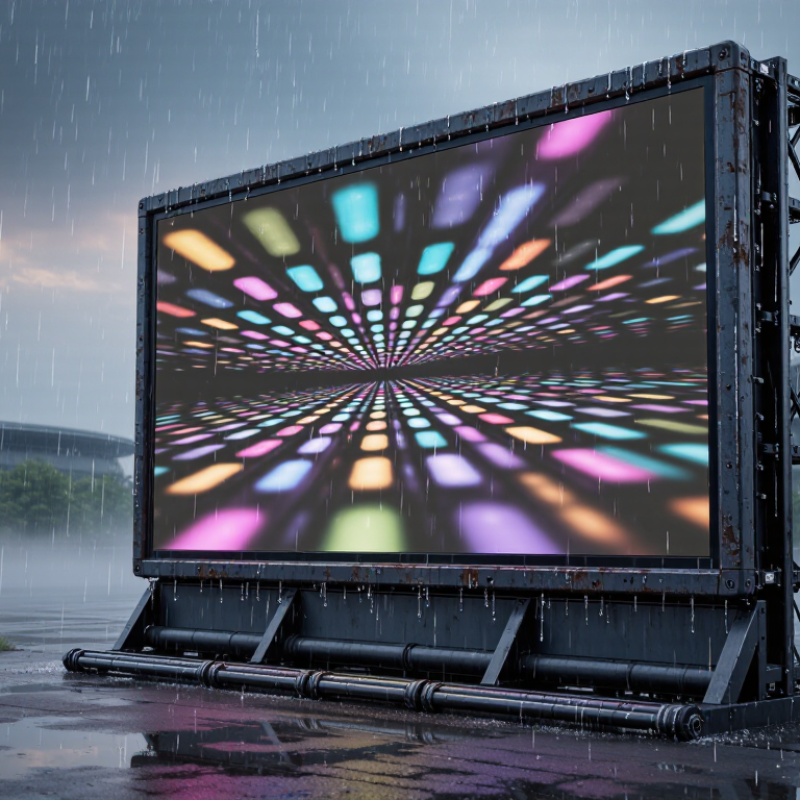
What Is a Waterproof Outdoor LED Screen?
A waterproof outdoor LED screen is a digital display engineered for rain, humidity, dust, sunlight, and changing temperatures. Unlike indoor panels, it uses sealed cabinets, protected connectors, drainage paths, and weather-resistant materials. Its purpose is not merely to display bright images outdoors. It must remain readable and electrically stable during real weather events.
Outdoor LED display engineer David Haynes puts it clearly: “Water resistance is a system, not a coating.” That principle matters. An enclosure may meet an IP65 or IP66 rating, yet poor installation can still create weak points. Water can enter through cable glands, damaged seals, or improperly closed doors. Small details matter.
A reliable waterproof outdoor LED screen usually combines high brightness, corrosion-resistant cabinets, thermal management, and reinforced module protection. Front and rear maintenance designs can also affect long-term sealing. For example, a screen beside a coastal road faces salt spray, while one near a stadium may experience vibration and frequent cleaning. The same specification may not suit both locations.
Experience changes the answer.
IP ratings help, but they do not guarantee perfect performance. They describe controlled test conditions, not every storm, installer, or maintenance habit. A careful evaluation should consider climate, viewing distance, wind load, power protection, ventilation, and service access. Sometimes, the most expensive screen is not the safest choice. The better choice is the one designed for its actual environment.
Definition and Core Features of Waterproof Outdoor LED Screens
What Is a Waterproof Outdoor LED Screen?
A waterproof outdoor LED screen is a digital display built to operate in rain, dust, sunlight, and changing temperatures. Its cabinet uses sealed joints, protected connectors, and drainage paths to reduce water entry. The term “waterproof” should be read carefully. In practice, protection depends on the screen’s tested IP rating, installation quality, and maintenance.
Core features include high brightness, strong contrast, and weather-resistant materials. Brightness helps content remain visible under direct midday sun. A sealed cabinet protects LED modules and internal circuits from moisture. Some designs also use conformal coatings, which add another layer of protection to sensitive components. Proper ventilation matters too. Heat trapped inside the cabinet can shorten electronic life, even when rain stays outside.
From field experience, mounting angle and cable placement often matter as much as the enclosure. Water can collect around poorly sealed cable glands or damaged doors. Regular inspections should check gaskets, screws, drainage holes, and pixel modules. A screen may survive heavy rain but fail after repeated freezing and thawing. Not magic.
Reliable operation also requires suitable brightness control and temperature management. Excessive brightness wastes energy and may reduce component life. Specifications are useful, but they cannot replace a careful site assessment. This is where many installations still need improvement.
How Waterproof Outdoor LED Screens Are Designed and Built
What Is a Waterproof Outdoor LED Screen?
How Waterproof Outdoor LED Screens Are Designed and Built
A waterproof outdoor LED screen is engineered for rain, humidity, dust, and changing temperatures. Its protection begins with a sealed cabinet, not the display surface alone. Designers use tight gaskets around doors, module edges, and service openings. Drainage channels help remove water that enters during maintenance. Small details matter.
The enclosure commonly uses corrosion-resistant materials and carefully sealed cable connectors. Protective coatings can shield circuit boards from moisture and condensation. However, coatings are not a substitute for proper cabinet design. An outdoor screen also needs controlled airflow, because sealed electronics can overheat under direct sunlight. Ventilation systems must block water while releasing heat. That balance is difficult.
Manufacturers test protection with water spray, dust exposure, temperature changes, and repeated cabinet opening. An IP rating provides useful guidance, but installation quality remains critical. A damaged gasket, loose connector, or poorly sealed cable can create a weak point. Field technicians often inspect mounting angles, drainage paths, and fasteners before energizing a screen. They should also check these areas after severe weather.
No design is flawless. Even a well-tested cabinet can fail after years of vibration, ultraviolet exposure, or careless servicing. Regular inspections help reveal aging seals and trapped moisture. Waterproofing is a system, not a single feature. Each layer must work together.
Key Performance Specifications and Waterproofing Standards
What Is a Waterproof Outdoor LED Screen?
A waterproof outdoor LED screen is built for rain, dust, sunlight, and changing temperatures. Its key protection level usually comes from the IP rating, defined by IEC 60529. IP65 means complete dust protection and resistance to water jets. Many outdoor displays use IP65 on the front and rear. IP66 offers stronger water-jet protection, but it does not permit immersion. Check both sides.
Brightness commonly ranges from 5,000 to 7,000 nits for direct sunlight. A refresh rate above 1,920 Hz helps reduce flicker on camera. Important specifications also include operating temperature, UV resistance, corrosion protection, drainage design, and power-supply safety. Field inspections often reveal weak cable seals or poorly fitted cabinet doors. A high IP number cannot repair careless installation. This needs attention.
Tips: Ask for the complete IP test report, not only a product label. Inspect gaskets, connectors, ventilation paths, and cabinet joints. Confirm the testing standard and sample conditions. Regularly remove dust from drainage openings. Do not assume “waterproof” means maintenance-free. Even a certified screen can fail when standing water, salt air, or damaged seals are ignored.
What Is a Waterproof Outdoor LED Screen? - Key Performance Specifications and Waterproofing Standards
| Performance Dimension | Typical Outdoor Specification | Why It Matters | Relevant Standard or Test Reference |
|---|---|---|---|
| Definition of a Waterproof Outdoor LED Screen | Weather-resistant LED display designed to operate outdoors with sealed modules, protected electronics, drainage paths, and corrosion-resistant construction. | Outdoor displays must withstand rain, dust, humidity, sunlight, and temperature changes. “Waterproof” generally describes a tested level of protection, not unlimited underwater operation. | Ingress protection is classified under IEC 60529. |
| Front Ingress Protection | IP65 is a common minimum target for outdoor LED display faces. IP66 provides higher protection against powerful water jets. | The first digit protects against dust; the second digit indicates resistance to water ingress. | IEC 60529: IP6X indicates dust-tight protection; IPX5 resists water jets and IPX6 resists powerful water jets. |
| Rear Ingress Protection | Typically IP54 to IP65, depending on cabinet design, installation position, ventilation method, and maintenance requirements. | The rear often contains power supplies, connectors, and ventilation areas, so its protection level may differ from the front. | IEC 60529 testing should specify the protected side and the complete assembled product. |
| Impact Protection | IK08 to IK10 is commonly selected for public-facing installations; the required rating depends on the risk of accidental or deliberate impact. | Impact resistance protects the cabinet, mask, front cover, and LED modules from mechanical shock. | IEC 62262 defines IK impact protection ratings. IK10 corresponds to a 20-joule impact test. |
| Pixel Pitch | Approximately 2.5–10 mm for many outdoor applications; larger pitches are often used when the viewing distance is greater. | Pixel pitch affects image resolution, viewing distance, cabinet cost, and power consumption. | Specified in millimeters as the center-to-center distance between adjacent pixels. |
| Brightness | Typically 5,000–10,000 cd/m² for direct-sunlight outdoor displays. Lower levels may be suitable for shaded locations. | Sufficient brightness improves daylight readability, while automatic dimming helps reduce glare and energy use at night. | Brightness should be measured under a defined test condition, commonly expressed in candelas per square meter. |
| Automatic Brightness Control | Ambient-light sensor with scheduled or automatic dimming; nighttime output is commonly reduced substantially from the daytime level. | Controls glare, improves visual comfort, and reduces unnecessary power consumption. | System performance depends on sensor calibration, control software, and local lighting requirements. |
| Refresh Rate | At least 1,920 Hz for general video; 3,840 Hz or higher is often preferred for camera-friendly and broadcast-related applications. | A higher refresh rate reduces visible scan lines, flicker artifacts, and rolling-band effects in camera footage. | Verify the measurement method because refresh rate and scan frequency are not identical specifications. |
| Viewing Angle | Horizontal viewing angle commonly ranges from 120° to 160°; vertical viewing angle is often about 100° to 140°. | A wide viewing angle helps maintain consistent brightness and color for audiences positioned away from the screen center. | Manufacturers should state the brightness or contrast criterion used to define the angle. |
| Color and Image Performance | True-color processing with 8-bit or higher per-channel processing; grayscale capability may reach 14–16 bits depending on the control system. | Higher processing depth supports smoother gradients, better shadow detail, and more natural transitions. | Actual image quality also depends on calibration, LED binning, receiving cards, and content processing. |
| Operating Temperature | Common design range: approximately −20°C to +50°C. Extended ranges may be available for severe climates. | Thermal design affects LED lifetime, color consistency, power-supply reliability, and startup performance. | Temperature limits should be verified for the complete system, including control equipment and power supplies. |
| Operating Humidity | Often specified at 10%–90% relative humidity, non-condensing. Condensation control may be required in humid environments. | Condensation can cause corrosion, insulation breakdown, short circuits, and optical defects. | Humidity limits should be stated together with temperature because condensation risk depends on both conditions. |
| Thermal Management | Passive heat dissipation is preferred where practical; fans, filters, or air-conditioning may be used for high-power or enclosed designs. | Efficient heat removal helps prevent thermal stress and maintains stable brightness and color performance. | Cabinet ventilation must be designed without compromising the declared ingress protection rating. |
| Power Consumption | Typical maximum consumption may be approximately 500–1,000 W/m², while average operating consumption is often lower, depending on content and brightness. | Power figures affect electrical capacity, operating cost, heat generation, and backup-power sizing. | Always distinguish maximum power from average power and identify the brightness level used for testing. |
| Electrical Protection | Common provisions include overcurrent, overvoltage, short-circuit, surge, leakage, and over-temperature protection. | Protection features reduce the risk of equipment damage caused by unstable utility power, lightning-related surges, or internal faults. | Applicable electrical and EMC requirements depend on the installation country and system configuration. |
| Grounding and Surge Protection | Protective earthing, equipotential bonding, suitable surge protective devices, and correctly rated outdoor cabling. | Outdoor metal structures and long cable runs can increase exposure to lightning-induced surges and electrical noise. | Installation should follow local electrical codes and the project’s lightning-protection design. |
| Cabinet and Material Protection | Aluminum or coated steel cabinets with sealed gaskets, treated fasteners, protected connectors, and corrosion-resistant coatings. | Material selection helps resist rust, salt mist, UV exposure, and repeated wet-dry cycles. | Coating, corrosion, and environmental tests should be selected according to the site conditions. |
| Connector and Cable Sealing | Outdoor-rated connectors, sealed cable glands, gasketed access doors, and downward-facing or protected cable entries. | Water frequently enters through connectors, cable openings, door seals, or poorly routed cables rather than through the LED surface itself. | The complete installed connection system should be tested, not only individual components. |
| Drainage and Condensation Control | Drain holes, sloped surfaces, breathable membranes, anti-condensation measures, and accessible inspection points where required. | Drainage prevents trapped water, while pressure equalization and ventilation can reduce internal condensation. | Drainage features must not create openings that invalidate the declared IP rating. |
| UV and Weather Resistance | UV-stabilized plastics, weather-resistant coatings, outdoor-rated seals, and materials selected for prolonged solar exposure. | UV degradation can cause cracking, discoloration, brittleness, seal failure, and reduced mechanical protection. | Material and accelerated weathering tests should match the expected outdoor exposure and regional climate. |
| Serviceability | Front or rear service access, replaceable LED modules and power supplies, modular data connections, and documented maintenance procedures. | Easy service reduces downtime and lowers the risk of damaging seals during repairs. | After maintenance, all gaskets, fasteners, cable glands, and covers should be correctly restored before retesting. |
| Recommended Verification | Request an IP test report for the assembled cabinet or display, electrical safety documentation, environmental test results, and installation instructions. | Marketing descriptions alone do not confirm that the complete installed screen achieves the stated protection level. | Confirm test scope, sample configuration, test conditions, date, and whether the report applies to the final product design. |

Installation Methods and Environmental Adaptability
What Is a Waterproof Outdoor LED Screen? Installation Methods and Environmental Adaptability
A waterproof outdoor LED screen is designed to operate through rain, dust, sunlight, and changing temperatures. Its protection depends on sealed cabinets, covered connectors, drainage paths, and properly fitted gaskets. In practice, “waterproof” does not mean invulnerable. Water can enter through an overlooked cable joint or a damaged seal. That detail is easy to underestimate.
Installation begins with the site structure. A wall-mounted screen needs a level, load-bearing surface and enough rear clearance for ventilation. Pole-mounted displays require wind-load calculations, strong foundations, and secure cable routing. Freestanding frames should include drainage below the cabinets, because trapped water can corrode fasteners and electrical parts. Technicians should also leave service space behind each module. Tight access makes routine maintenance slower and riskier.
The environment changes the installation method. Coastal locations need corrosion-resistant hardware and frequent inspections because salt air attacks metal surfaces. Hot areas require airflow and temperature monitoring, while cold regions may need controlled heating during startup. Direct sunlight can reduce visibility, so brightness should be adjusted with ambient-light sensors rather than kept at maximum power. Use certified grounding, surge protection, and weather-rated connectors. Local engineers should verify wind, electrical, and structural requirements before installation. I have seen projects focus on screen brightness while neglecting drainage. That mistake can become expensive after one storm.
Common Applications, Maintenance, and Service Life
What Is a Waterproof Outdoor LED Screen?
A waterproof outdoor LED screen is built for rain, dust, sunlight, and temperature changes. Its sealed cabinet, protected connectors, and drainage paths help prevent trapped moisture. In practice, “waterproof” does not mean maintenance-free. Outdoor screens appear at stadium entrances, shopping centers, transport hubs, festivals, and roadside advertising sites. They display schedules, safety notices, scores, and live images in bright daylight. Viewing distance matters.
Installers should check the enclosure rating, mounting structure, ventilation, and cable entry points before operation. A screen near the coast may need more frequent inspections because salt air accelerates corrosion. After heavy rain, qualified technicians should examine water marks, loose seals, dark modules, and unusual flicker. Power should be isolated before opening any cabinet. Soft brushes and dry, lint-free cloths are safer than aggressive chemicals or high-pressure water. This detail is easy to overlook. Filters, fans, drainage holes, and connectors need scheduled cleaning. Blocked ventilation can shorten component life.
With stable power and regular servicing, many outdoor LED screens operate for seven to ten years. Actual service life depends on brightness settings, climate, daily runtime, installation quality, and repair response. Running maximum brightness every night may improve visibility, but it can increase heat and energy use. A practical maintenance log should record inspections, faults, module replacements, and temperature readings. Some failures appear slowly. A dim corner today may become a larger display fault tomorrow. I would not promise an exact lifespan without site data, because real conditions often challenge laboratory estimates.
What Is a Waterproof Outdoor LED Screen?
Waterproof outdoor LED screens are designed with sealed cabinets, weather-resistant components, and ventilation systems to withstand rain, dust, sunlight, and temperature changes. Their service life depends on operating hours, climate, brightness, installation quality, and maintenance.
Typical service life by application: Outdoor LED displays commonly provide about 7–10 years of service when properly installed and maintained. Regular cleaning, inspection of seals and cables, ventilation checks, and timely replacement of damaged modules can help preserve image quality and reliability.