How to Source LED Flexible Strip Lights in 2026?
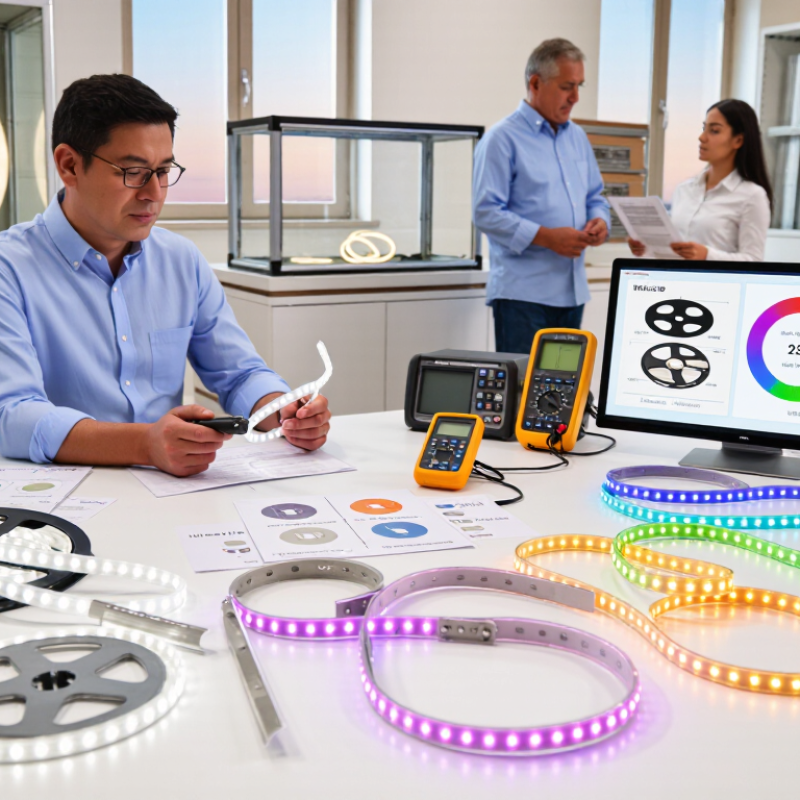
Sourcing LED strip lighting in 2026 requires more than comparing prices on a supplier website. Buyers must connect product specifications with real installation conditions. Led Flexible products differ in brightness, color quality, voltage, waterproofing, and heat management. A bright sample may still fail inside a warm display cabinet.
Reliable sourcing begins with a clear technical brief. Define the required color temperature, CRI, wattage per metre, LED density, cutting points, and bending direction. Check the stated IP rating against the actual environment. Ask for samples, test reports, production photographs, and recent quality records. Details matter. A supplier should explain how its product handles voltage drop across longer runs. It should also identify the correct aluminium profile and power supply.
Supplier evaluation needs practical evidence, not attractive promises. Review factory capacity, traceability, warranty terms, packaging, minimum order quantities, and lead times. Confirm whether certifications apply to the exact model, not merely to the company. Independent testing can reveal problems that a showroom sample hides. In my experience, early samples often look better than bulk production. That risk deserves attention. No sourcing plan is perfect, especially when component availability changes quickly. Therefore, keep a backup supplier and approve a controlled sample before placing a large order. A careful process protects brightness, safety, installation performance, and long-term customer trust. It also makes future purchasing easier, because every decision has documented evidence behind it.
Define Project Requirements for LED Flexible Strip Lights
How to Source LED Flexible Strip Lights in 2026?
Define the project before contacting suppliers. Record the installation length, mounting surface, indoor or outdoor location, and daily operating hours. Specify the required brightness in lumens per meter, not only wattage. Select the color temperature, color rendering target, and acceptable color tolerance. A retail display may need high color accuracy, while cabinet lighting may prioritize soft output.
Match electrical details carefully. Confirm the system voltage, power per meter, cutting interval, connector type, and dimming method. Calculate total load with at least a sensible reserve for long runs. Do not ignore voltage drop. A five-meter sample may look perfect, while a twenty-meter installation becomes visibly uneven. Ask for photometric data, thermal guidance, test reports, and applicable safety certifications for the destination market.
Check physical performance in a real sample. Test the strip on the intended material, especially painted metal, wood, or textured plastic. Examine adhesive strength after heat cycles. Verify the minimum bend radius and ingress protection rating. In my experience, suppliers often provide clear electrical figures but vague durability claims. That gap deserves questions. I once approved a sample without checking connector clearance; installation later required unnecessary rework. Build a requirement sheet, but leave room to revise it after testing. Some assumptions will be wrong. That is useful to discover before placing a production order.
Compare LED Strip Types, Specifications, and Performance
How to Source LED Flexible Strip Lights in 2026?
Sourcing LED flexible strip lights requires comparing construction, not just wattage. Single-color strips suit shelves and task lighting, while tunable-white versions support changing color temperatures from warm to cool. RGB strips create saturated color, but they usually produce weaker white light. Addressable strips offer pixel-level control, although their wiring and software demand more testing.
Check LED density, voltage, power draw, color rendering, and thermal design. A 24V strip usually reduces voltage drop across longer runs than a 12V strip. High-density products can produce smoother light, especially in aluminum channels. Look for CRI 90 or higher when accurate material colors matter. The U.S. Department of Energy reports that modern LED systems can use at least 75% less energy than incandescent lighting and last up to 25 times longer. That figure describes LED lighting broadly, not every flexible strip.
Performance depends heavily on installation. A bare strip may look bright on a workbench but develop dark spots inside a deep profile. Aluminum channels help control heat; this detail is often underestimated. Market research from Grand View Research identifies energy efficiency and smart control as major LED lighting growth drivers through 2030. Still, published lumen claims can be optimistic. Request test reports, LM-80 data, binning information, and a measured sample before placing a large order. The sample may expose uneven color, weak adhesive, or excessive heat.
Evaluate Suppliers, Certifications, and Manufacturing Quality
When sourcing LED flexible strip lights in 2026, supplier evaluation should begin with evidence, not catalog claims. The International Energy Agency’s 2024 Energy Efficiency Market Report identifies LEDs as more than half of global lighting sales. That growth increases the risk of inconsistent quality. Request factory audit records, production photographs, process-control documents, and recent test reports. A serious supplier should explain LED binning, copper thickness, adhesive selection, and thermal management clearly.
Certifications need careful checking. Ask whether reports cover the exact strip model, voltage, color temperature, and production site. Relevant evidence may include IEC 60529 testing for IP protection, IEC 62471 photobiological safety assessment, and RoHS or REACH documentation where applicable. ISO 9001 supports process consistency, but it does not prove product performance. LM-80 data and TM-21 projections can support lumen-maintenance claims, although they should not replace real thermal testing. The U.S. Department of Energy’s solid-state lighting research reports continue to emphasize efficacy, reliability, and color quality as key development priorities.
Manufacturing quality appears in small details. Inspect solder joints under magnification, measure voltage drop across a five-meter reel, and compare brightness at both ends. Ask for burn-in results from completed batches. I have seen attractive samples fail after poor adhesive curing or uneven encapsulation. A supplier may provide excellent samples, then change components without notice. Include written change-control requirements and batch traceability. My own mistake was trusting a certificate date without checking its scope. That shortcut was expensive.
| Evaluation Area | Data Dimension | Recommended 2026 Benchmark | What to Verify | Supplier Evidence |
|---|---|---|---|---|
| Product Specification | Rated voltage | 12 V or 24 V DC, selected according to strip length, power level, and installation requirements. 24 V is generally preferable for longer runs because it can reduce current at the same wattage. | Confirm nominal voltage, allowable voltage tolerance, polarity marking, and whether the product is designed for constant-voltage operation. | Datasheet, product label, electrical test report, and sample inspection. |
| Power consumption | Specify power per metre and total circuit load. The actual measured value should remain within the supplier's declared tolerance under rated conditions. | Measure voltage, current, and power with a calibrated meter after thermal stabilization. Check whether power is stated per metre, reel, or cut section. | Signed datasheet, sample measurement record, and production inspection standard. | |
| LED density and cut length | Common commercial configurations include 30, 60, 120, or more LEDs per metre. A shorter cut interval generally improves layout flexibility and reduces visible dark spots. | Verify LED count per metre, cut-mark spacing, copper-pad design, minimum bending radius, and connector compatibility. | Dimensioned drawing, reel photographs, first-article sample, and incoming inspection checklist. | |
| Color temperature and color consistency | Typical CCT options include 2700 K, 3000 K, 4000 K, and 6500 K. For professional lighting, request consistent chromaticity and preferably a three-step MacAdam ellipse bin or tighter where available. | Check CCT tolerance, chromaticity coordinates, binning method, test distance, and whether all production lots use the same LED bin. | ANSI C78.377-related chromaticity data, integrating-sphere report, binning record, and approved color sample. | |
| Color rendering | CRI (Ra) of 80 or higher is common for general lighting; Ra 90 or higher is preferred for retail, hospitality, residential, and color-critical applications. | Review Ra and individual R-values, especially R9 when saturated red rendering is important. Do not rely only on marketing claims. | Independent or calibrated laboratory report using recognized color-measurement methods, including test conditions. | |
| Reliability and Thermal Design | Lumen maintenance | Request LM-80 data for the LED package and a TM-21 projection where applicable. A useful project target is L70 at least 36,000–50,000 hours, but the result depends on temperature and drive current. | Check the test temperature, drive current, sample quantity, extrapolation period, and whether the data applies to the actual LED package used. | LED package LM-80 report, TM-21 calculation, and product-level life estimate. |
| Thermal management | Use an aluminum profile or another suitable heat-dissipation method for medium- and high-power installations. The LED strip should not be evaluated without its intended mounting condition. | Measure LED solder-point or case temperature under rated ambient conditions. Review thermal derating, adhesive contact, and profile compatibility. | Thermal test report, infrared images, mounting instructions, and maximum ambient-temperature specification. | |
| PCB and soldering quality | Specify copper thickness, PCB width, solder-mask quality, component placement, and resistance to cracking during bending and installation. | Inspect copper traces, solder joints, resistor placement, LED alignment, solder coverage, and cut-pad integrity under magnification. | PCB stack-up or copper-weight declaration, IPC-based workmanship criteria, and inspection records. | |
| Voltage drop and line uniformity | Set a project-specific maximum brightness difference across the intended run. Feed points, parallel wiring, higher voltage, and suitable copper design can reduce voltage-drop effects. | Test the complete specified run at the far end, not only a short sample. Record illuminance or luminance uniformity and input/output voltage. | Full-length sample test, wiring diagram, maximum-run recommendation, and installation guide. | |
| Ingress Protection and Safety | Ingress protection rating | IP20 is intended for dry indoor locations. IP65, IP67, or IP68 may be selected for exposure to dust or water, provided the construction and end sealing match the application. | Verify that the tested construction is identical to the supplied version, including silicone, extrusion, end caps, cable exits, and connectors. | IP test report to IEC 60529, construction photographs, sealing specification, and sample verification. |
| Electrical safety | Product design should address insulation, creepage, clearance, accessible conductive parts, short-circuit protection, and compatibility with the constant-voltage power supply. | Check the applicable requirements for the complete lighting system, including the strip, power supply, controller, wiring, and connectors. | Safety test report, wiring diagram, risk assessment, and power-supply compatibility statement. | |
| Photobiological safety | Request a photobiological risk assessment for the finished product. IEC 62471 is commonly used to evaluate optical radiation safety from lamps and lamp systems. | Confirm the risk group, measurement distance, optical configuration, diffuser or lens condition, and intended viewing environment. | IEC 62471 test report or equivalent documented assessment from a qualified laboratory. | |
| Flammability and material behavior | For projects requiring fire performance, specify the required material class and test method rather than accepting an unspecified “fireproof” claim. | Verify the exact jacket, adhesive, PCB, connector, and profile materials used in production. | Material declarations, applicable flammability test reports, and production-material traceability. | |
| Environmental Compliance | RoHS compliance | Products supplied to markets applying the RoHS framework should meet the restricted-substance limits under Directive 2011/65/EU and applicable amendments. | Confirm that the declaration covers the complete strip assembly, including LEDs, resistors, PCB, solder, coating, cable, and connectors. | RoHS declaration, material test report, and supplier substance-control procedure. |
| REACH and substance disclosure | For European-market supply, review obligations under Regulation (EC) No 1907/2006 and check for substances of very high concern where applicable. | Ask for the latest SVHC declaration and a process for updating declarations when the candidate list changes. | REACH/SVHC declaration, full material declaration, and compliance-update procedure. | |
| Conflict minerals and responsible sourcing | Where required by the buyer or market, request responsible-sourcing information for relevant minerals and key upstream materials. | Check whether the supplier maintains a documented supply-chain questionnaire and escalation process. | Supplier code of conduct, due-diligence policy, and standardized supply-chain reporting. | |
| Country- or market-specific requirements | Compliance requirements vary by destination, installation type, and whether the product is sold as a component or a complete luminaire. | Define the destination market before testing and confirm whether the controller, driver, plug, and complete assembly require additional approvals. | Market-specific compliance matrix, declarations, and test reports matching the final configuration. | |
| Supplier Capability | Quality management system | ISO 9001 certification is a useful indicator of a documented quality-management system, but it does not by itself certify product performance. | Check certificate validity, certification scope, manufacturing site, audit status, and corrective-action process. | Valid certificate issued by an accredited certification body, audit summary, and quality manual excerpts. |
| Production traceability | Every reel or batch should be traceable to LED lot, PCB lot, assembly date, operator or line, inspection result, and shipment record. | Select a shipped reel at random and test whether the supplier can retrieve all related records promptly. | Lot-code format, ERP records, batch labels, inspection reports, and retention policy. | |
| Process control and inspection | A robust process normally includes incoming-material inspection, soldering or assembly controls, in-process checks, aging or burn-in where specified, and final inspection. | Review acceptance criteria for electrical output, color, appearance, adhesive, cutting, packaging, and labeling. | Control plan, work instructions, inspection checklist, calibration records, and nonconformance reports. | |
| Capacity and continuity | Evaluate realistic monthly capacity, lead time, minimum order quantity, component availability, and the supplier's ability to maintain the approved specification. | Ask how the supplier manages component substitutions, peak demand, tooling, maintenance, and production-site changes. | Capacity statement, lead-time history, continuity plan, approved-substitution procedure, and production schedule sample. | |
| Commercial and Sampling Controls | Sample approval process | Approve a golden sample with defined electrical, optical, mechanical, color, packaging, and labeling characteristics before mass production. | Keep signed samples or controlled photographs and specify which deviations require written approval. | Approved sample record, specification sheet, deviation form, and pre-production checklist. |
| Independent pre-shipment inspection | Use risk-based inspection for the first order and periodically thereafter. Inspection should compare production goods against the approved specification, not only count cartons. | Include sampling level, critical defects, major defects, minor defects, electrical tests, color checks, and packaging verification. | Third-party inspection report, sampling plan, defect classification, and corrective-action record. | |
| Warranty and failure handling | Define warranty duration, eligible failure modes, return procedure, response time, replacement policy, and responsibility for field-failure analysis. | Check whether warranty exclusions are reasonable and whether failure data is analyzed by lot and root cause. | Written warranty, RMA procedure, 8D or root-cause template, and historical corrective-action examples with confidential data removed. | |
| Total cost of ownership | Compare not only unit price but also driver cost, aluminum profiles, connectors, shipping volume, energy use, installation labor, warranty risk, and replacement cost. | Calculate cost per metre of delivered light output and include the specified lifetime, efficiency, and installation configuration. | Itemized quotation, energy-performance data, packaging dimensions, accessories list, and landed-cost model. | |

| Recommended decision rule: shortlist suppliers only after confirming product samples, applicable certifications, traceability, manufacturing controls, and destination-market compliance. Certifications should be checked for validity, issuing body, tested product configuration, and manufacturing site; a certificate or declaration should not be treated as proof that every supplied batch has identical performance. | ||||
Calculate Costs, Quantities, Lead Times, and Import Requirements
How to Source LED Flexible Strip Lights in 2026?
Sourcing begins with a complete cost model, not the reel price alone. Calculate the required lighting length from the approved floor plan. Add 5–10% for cutting waste, damaged sections, and installation changes. Then check wattage per meter, voltage, color accuracy, waterproofing, controllers, power supplies, aluminum profiles, connectors, packaging, freight, import duty, and local taxes.
A 100-meter order can need several power supplies, not one large unit. That detail affects both price and safety.
Lead times should be measured by project stage. Samples may take several days, while customized production can require two to five weeks.
Add time for testing, packing, port handling, customs clearance, and inland delivery. Ask for a written production schedule with inspection dates. My early estimates were too optimistic because I ignored holiday congestion and connector shortages. Build a buffer. It matters.
Import requirements depend on the destination country and product configuration. Request a commercial invoice, packing list, transport document, declared HS code, origin information, and applicable conformity or safety documents.
Confirm whether the importer needs special electrical markings, energy information, or product registration. Requirements can change, so verify them with customs authorities or a qualified broker.
Check the invoice carefully. Incorrect voltage, quantities, or product descriptions can delay clearance and create unexpected charges.
Keep one approved sample for comparison during receiving inspection.
Inspect Samples and Finalize a Reliable Sourcing Agreement
How to Source LED Flexible Strip Lights in 2026?
Inspecting samples should be more than checking whether the strip looks bright. I power each sample for several hours before judging it. I measure voltage at both ends, because brightness can fall after a long run. I also check color temperature, CRI, LED spacing, PCB width, and solder quality. Small details matter. The adhesive backing should hold firmly on a clean aluminum profile. I test it on painted and slightly dusty surfaces too. Real installations are rarely perfect.
Ask the supplier for photometric data, electrical test reports, and material specifications. Confirm the rated input voltage, power consumption, IP protection level, operating temperature, and expected lifetime. I cut sections from different reels and compare their color consistency. One careless sample can hide batch variation. I once focused too heavily on brightness and overlooked uneven color bins. That mistake would have been expensive in a large installation.
A reliable sourcing agreement must convert every approval into written requirements. Include drawings, tolerances, packaging rules, inspection methods, production timelines, and replacement terms. Define what happens when samples pass but bulk goods fail. Payment milestones can follow inspection results, not promises alone. Require batch labels and retained samples for traceability. Changes to LEDs, resistors, adhesives, or suppliers should need written approval. Leave room for reasonable discussion. Specifications can be incomplete, and pretending otherwise creates disputes. Review the agreement with an independent technical adviser when the project is critical.
How to Source LED Flexible Strip Lights in 2026?
Inspect Samples and Finalize a Reliable Sourcing Agreement
Use these sample-approval checkpoints before signing a sourcing agreement. The acceptance targets reflect common procurement requirements for voltage stability, light quality, thermal performance, ingress protection, and production consistency. Approve samples only when every critical checkpoint meets the agreed specification.
Related Posts
-
Exploring LED Flex Innovations at the 138th Canton Fair 2025: Industry Growth Insights and Market Trends
-
Leading LED Linear Lighting Manufacturers from China at the 137th Canton Fair
-
10 Essential Tips for Choosing the Best Led Lighting Solutions?
-
How to Choose the Best Light Panels for Your Space?
-
Top 10 LED Flex Solutions You Need for Your Next Project
-
How to Choose the Perfect Led Recessed Lighting for Your Space